Embracing My Deaf Identity

home.JPG

There are a lot of struggles with being deaf in a hearing world, but also within our own deaf community. Unfortunately it is challenging to find my place in the deaf community even as a deaf individual.

I mentioned in the cochlear implants blog that there are many subgroups of the deaf community. I learned about them when I attended college at RIT (which also had a college for the deaf - National Technical Institute for the Deaf - NTID). During my childhood, I was mainstreamed with all hearing peers so I never truly found my identity until college.

NTID was more of a community college helping deaf students to earn associate degrees. The goal after associate degrees is to either enroll in a bachelors degree program at RIT or transfer to another university for further education. The majority of deaf students were accepted through NTID, but very few were able to transfer into RIT immediately on enrollment depending on their academic success. I spent my first term in NTID then I was enrolled into RIT under the criminal justice program. I was one of three deaf students in the program at the time. Sometimes I would have them in my classes and sometimes I would be the only one. It was more difficult for me to socialize with my deaf peers being mainstreamed again, I had to go seek them out.

For this reason, in my first year of college, I decided to join a deaf sorority. I wanted deaf “girlfriends” so that I could have shopping buddies, I wanted to do all the girly things that I missed out on during childhood and find my future bridesmaids. This helped me to be involved in the deaf world at RIT. Many girls came from all kinds of deaf lives so I learned a lot from them. The sorority was involved in a lot of activities and events at NTID, I was able to socialize with my deaf peers outside the sorority as well. I also learned so much about my deaf culture from my sisters, I never knew there was a famous deaf rapper who happened to be married to my big-big sister’s biological sister - Sean Forbes. I was amazed when we went to one of his concerts and saw him rapping in sign language! The sorority had about 50-60 sisters so there were still “cliques” of girls (mostly based on the subgroups of the deaf community that I had discussed). It was still difficult for me to find my place. I formed a friendship with one who became my best friend who I did everything with. I was disappointed that I didn’t leave with a group of girlfriends as I hoped but I did leave with a lot experiences because of them. The sorority gave me a huge start in exploring my identity.

Another factor that helped me to find my identity was my deaf best friend that I met at a summer camp, before attending RIT. My best friend actually is a Rhode Islander (I had NO idea that I would eventually be a New Englander!). We did everything together in the first two years of college. He taught me a lot about the deaf culture and community. We had a different school upbringing but yet we clicked so well. He attended a deaf institute in Rhode Island before coming to RIT. I saw his self confidence as a deaf individual which helped me to build up mine. When we would go places, I would see him confidently talking to people using his voice or writing (this was in the days before notes were available on phones). He wasn’t afraid to try. He was a very sociable person, and as I was a shy person, that helped me to come out of my shell.

I had a turbulent time during college figuring out where I belonged. I HATED Rochester. Not kidding. I felt like I wasn’t fitting into any groups. I got homesick. I went home every weekend in mid college years. This didn’t help my social life. I realized that I didn’t appreciate the friends that I did have. I closed them off. Luckily for me, some of them were still there at the end. It was a long difficult journey but I did finally accepted myself as a deaf individual.

That time finally came for me in my final year at RIT. It was the greatest feeling. I spent my whole childhood wondering why I was chosen to be different. Being in Rochester changed that perspective for me. It was the closest to a “normal” life that I could ever have. Rochester is much more accessible for the deaf community. Going out to public places was comfortable, hearing people were aware of us. They were used to knowing how to communicate with us and familiar with our “deaf accents”. It was normal to sit at a red light in traffic and see deaf people signing in the car next to you. It was normal to see deaf people signing at Wegman’s while grocery shopping. It was normal for a deaf person to drive right up to the drive-thru window to place an order. There were even deaf professionals in the community such as veterinarians, counselors, dentists, etc. I didn’t feel different at all. I felt at HOME in Rochester.

ritgrad.jpg

Why would I move away from Rochester?

I get that question PRETTY OFTEN, even today. I moved to Connecticut shortly after my graduation. Honestly, I did not want to leave Rochester at first. I realized in 2017 that I wanted to stay in New England. As difficult as it was to leave Rochester, the only thing I truly loved about Rochester was feeling that normality but my heart was destined to be near the shoreline.

Moving to Connecticut was an another challenge to start all over in the deaf community. Unfortunately, I am in a “dry spot” in CT, where a deaf community is almost non-existent and there are very few deaf people locally. I would have to drive an hour up to Hartford, CT or Providence, RI to participate in deaf social events. I met the local deaf people, it was hard to socialize with them since they all had kids and I didn’t. I liked them but it wasn’t easy finding things to do together. I was excited when a local event popped up at the casino close by. I was nervous to attend but when I did, only one deaf person talked to me. Another event that I went to, I finally was able to talk to more deaf people but most of the questions I got was criticizing the lifestyle that I chose. They weren’t accepting of me. This drove me away from socializing in further events.

I did get a chance to work at a deaf school up in Hartford, CT. The majority of the staff there were deaf. I was able to socialize with deaf co-workers but I was faced with that acceptance issue again. I was told that many deaf people in Connecticut are protective of their deaf community so they aren’t always welcoming of newcomers. I was upset about that because with the deaf community being so small and with only so few of us, I would think they would be more accepting to have more friends who speak their language and understand their culture. We face discrimination often so I was shocked to get that from my own community. Another thing is that I also was told that I wasn’t “deaf enough”. They were able to understand me when we communicate via sign language. I understand most of deaf culture from what I learned in college. Yet I was still not “deaf enough” because of my mainstreamed upbringing. It is very frustrating.

It is very lonely to be alone in CT but this is when I realized the importance of keeping in touch with my deaf friends from RIT online and via text messaging. I am SO lucky to have them! The distance and going through this difficult experience has helped some of those friendships to grow. I have found that many of them are going through similar experiences of not fitting in their local deaf communities, it isn’t just CT where this is occurring. It shouldn’t be challenging because living life as a deaf individual is already challenging enough!

These experiences have made me stronger BUT I do have my bad days. I learned that it helps to go to Rochester to reset myself. Ironically the place that I once hated has became a place to reset. Those trips are always good because it brings back my confidence and motivation as a deaf individual being back at home around deaf people in the deaf world. I feel better once I feel that normality. It reminds me of the journey I went through to love myself as a deaf person. Rochester is always going to be home for me, a place where I can truly be who I am. I can live with the fact that I won’t have that normality every day but Rochester will always be there for me when I need home. There are still times when I wish I could move back to Rochester permanently, but for now New England has my heart.

roc.jpg

Between Two Worlds: Growing Up Deaf in Mainstream Schools

Happy Deaf Awareness Month!

This past week I saw a post that was frequently shared over Instagram. The post quoted “I don’t want to turn a Deaf child into a hearing child. I want to help a Deaf child who struggles become a Deaf child who doesn’t struggle”. Those words just really got to me! It made me reflect on my mainstreamed childhood in the public schools. I had some tough times but also gained a lot from my experiences. It’s important to have the best education but at same time, make sure it fits the needs of each individual. Not all deaf people are the same, so the needs varies!

I was mainstreamed in a public school in Upstate New York my entire life. Being mainstreamed was very challenging. I first attended an elementary school across town that had a specialized classroom for students with hearing loss as well as other disabilities. There was an average of 13 students in the classroom every year. I would spend half of the day in the classroom working on speech and writing.

Let’s go off track for a bit so I can explain why writing was a huge focus for me. Grammar is a common weakness for Deaf people. American Sign Language and English are different language, with different grammar rules. Because of our hearing loss we are not learning the linguistics patterns; therefore, writing can be challenging for many. You can see this sometimes when a Deaf person would write the way they sign. Example: (English) How are you? (ASL - how we would sign) How you? Often when using ASL, the verbs (is, be, am, were, etc) aren’t signed. ASL follows different word orders than spoken English.

I hope this clarify why I needed more time to work on writing and with grammar than an average student needed. So again, my typical day consisted of spending the morning in the special education classroom then in the afternoon, I went to my mainstreamed class. This is when I ate lunch with my peers, attended specials (PE/music/art/library) classes and learn other core subjects (math/science/social studies).

I attended that elementary school up to the 4th grade. Since the school wasn’t in my neighborhood, I had to commute daily on a bus. I begged my parents to let me go to the local elementary school in my neighborhood. I badly wanted to be at same school as my brother and the local kids from my neighborhood. My parents had to fight for me to be allowed to transfer schools. The school I was going to had the special classroom equipped with interpreters, Teacher of the Deaf and speech services. The district didn’t want to pay additional for those services at the local school. Thankfully my parents didn’t give up on the fight and I was able to go to the local school for 5th and 6th grades.

It was one of the best decisions for me to transfer schools. Despite the challenges, it was worth it in the end. The experience made me grow a lot and learn how to be my own advocate. I made local friends. I had grown up watching my brother have local friends who were able to come over to play. My friends from my first school never did that since it was across town. When I transferred to the local school, I made many local friends who were able to play with after school. I had best friends. I had sleepovers. I went to birthday parties. I went to friends’ houses for play dates. I was having the normal friendships that I watched my brother have.

One of the second grade teacher at my local school heard about my upcoming arrival the following year so she hosted a sign language club after school. I was allowed to come as a guest to help her teach kids basic ASL. I made a few friends. This helped tremendously with the first day jitters! I walked into the class immediately knowing some friends because of the club. I was very grateful for that teacher to open doors for friendships! She has no idea how her actions with the sign language club became a major asset for my transition into the new school.

Being at the local school was very different. I felt that because I was clumped in with the special education kids at the first school, it was hard for others to see me as an independent person. While at the local school, I was the only deaf student. Everyone was intrigued with my deafness. They really took the time to get to know me and learn my language and communicate with me. I was more involved in other activities and plays because they saw my ability. I even announced the weather reports over the loudspeakers daily to practice my speech skills! Attending the local school really allowed me to thrive and build my independence.

I went onto middle school and high school with my friends. It became more difficult to socialize with my peers as we got older. It was easier in elementary schools when kids were more willing to learn sign language. ASL was old news by the time we got to high school. Some friendships drifted away, but I still gained new ones.

Some have asked me over the years why I didn’t go to Rochester Deaf School for the Deaf (RSD) in Rochester, NY. Despite the 2 hours drive, it was the closest deaf institute to my hometown. It was common for almost every deaf kid from my area to attend RSD for middle and high school. While I was in middle school, my parents took me to RSD and New York State School for the Deaf (NYSSD) in Rome, NY. We toured the schools and my parents left the decision completely up to me if I wanted to attend.

First of all, it was amazing for me to see a class taught in my language - sign language. Some teachers were deaf too! I was blown away at how this was reality. It’s what I have always dreamed of, a perfect world where everything is spoken in my language and everyone was deaf. I followed students my age around for the day at both deaf institutes. I went to their classes with them. I ate lunch with them. I played in P.E. class with them. It was so much fun communicating completely in my language with people who understood me. The world that day was fully immersed in deaf culture. That was the biggest pro of deaf institutes - I would not suffer with socializing aspect. Education was whole other story.

I was disappointed from my observations in the classes that I attended how far behind they were. I was in 7th grade at the time, and they were teaching materials that I had learned in 5th grade. The classes were much smaller with a range of 5-7 students. I can’t exactly say why the education at the time of my visit was behind - it could been lack of staff or resources. It could been that these students needed more time to learn things. Sometimes it can be delayed for deaf people to learn things. You can see an example of that from interpreters. When a speaker is talking, the interpreter has to listen then think about how to interpret that information, then interpret. We will always be a couple of minutes behind from receiving that information. What you see in few minutes with an interpreter can apply to teaching years worth of materials to deaf children. It may require some extra time for them to understand. Some deaf kids have language deprivation at young ages due to their parents not knowing what to do with them. It can delay the whole learning process because teaching them language is a priority in order for them to be able to receive information. I see this issue at NTID (deaf college in Rochester) too. Everyone’s learning processes varies.

It was a very difficult decision to pick opportunities over social life. The mainstreamed school offered so much more classes and activities that the deaf institutes didn’t. Another huge factor in my decision to stay at the mainstreamed school was wanting to stay local with my family and friends. If I had decided to attend the deaf institute, I would have to stay in the residential dorms during the week. The students travels to the institute every Mondays and travel back home on Fridays for the weekends. It was extremely hard for me to imagine that lifestyle because I grew up doing everything with my family, even during the week. I didn’t want to miss out on things with my family. I relied on seeing my family daily (back in the days before videophones existed!). I couldn’t imagine not seeing my brother, who is my best friend, every day.

This decision continue to come up through out my mainstreamed years. It got really difficult at times. There were times when I struggled with social life. I was lonely when I didn’t have many friends. It wasn’t easy. I thought about how different my life would have been if I took the deaf institute path. I have imagined all kinds of scenarios but in the end, I know it was the best decision for me. I knew I would eventually go to RIT/NTID for college which had the deaf community I was searching for. I just had to wait a bit longer to have that. My years in mainstreamed schools taught me a lot and made me learn how to thrive, how to be an advocate and how to be independent.

All opinion in this blog are my own. It does not reflect the opinions of other deaf members.

Is Ireland Deaf-Friendly? My Honest Experience

I was born into an Irish family with strong pride for our Irish heritage. I love everything Irish and about Ireland. It was natural that the first time I left America was for the beautiful countryside of Ireland. It was on my bucket list to see everything that my ancestral country had to offer. I recall being so nervous to leave the customs that I am familiar with especially with my deafness. I had no idea what to expect - how the people over there would react to my deafness? How will they talk to me if I didn’t understand them? Will they be more mean? Will I meet deaf people in Ireland and will they be nice?

Cliffs of Moher in County Clare, Ireland.

Cliffs of Moher in County Clare, Ireland.

First of all, the people in Ireland blew me away. They were AMAZINGLY nice! Ireland is very welcoming to its tourists, the Irish people are very helpful. I interacted with people daily and never came across a mean person. It made the whole experience of traveling through Ireland so much easier. It wasn’t hard to approach a local and get information.

One day I went to tour the House of Waterford Crystal in Waterford, Ireland. The admissions desk noticed that I was deaf when I was signing so they told me that there was someone on the factory tour that knew sign language. They said they would check if he was working that day and make sure that we meet. I figured it was just a hearing person who knew some sign to communicate with all the tourists that came through there daily. Boy, was I wrong! This is when I met my first Irish deaf friend, Brendan. It was first time seeing someone signing a whole new language - Irish Sign Language (ISL). Wait, what? Yes, that’s right - just like verbal language there are different sign language in each country. So many people think sign language is universal but it’s not! I was nervous about not understanding ISL and how to respond. Luckily our first interaction went well, it wasn’t hard to understand what he was saying since some signs were similar to American Sign Language. All sign languages are based on visual cues, I was able to pick up on what Brendan was saying to me - he was telling me about his job as Master Cutter and how long his co-workers had been employed at the Waterford Crystal Factory. I was able to learn some information about the Waterford Crystal Factory that I probably wouldn’t have known if not for meeting him. Whenever I go on tours and see hearing people have that accessibility to talk to people behind the scenes, it makes me sad that I don’t have that luxury due to language barriers. I was glad that I finally got that chance with Brendan. It was the highlight of my trip to Waterford Crystal Factory.

My Irish deaf friend, Brendan working at Waterford Crystal Factory.

My Irish deaf friend, Brendan working at Waterford Crystal Factory.

Many people that I interacted with in Ireland were very accommodating when I asked for information. When I was in Kilkenny, Ireland I walked in to the Smithwick’s factory into their gift shop to ask the employee for directions. That chat turned into an hour and half long conversation. I was there well past closing! She didn’t rush, taking the time to google things on the internet and draw up a map with lists of places to see for the rest of the time I was in Ireland. I came across another two women who were like this that drew up a map with written lists or directions for me. The girl from Smithwick’s was very fascinated with my deafness, the chat was filled of questions regarding that along with my questions about the general culture in Ireland. She was college aged and told me that she never met a deaf person.

I got the impression that many people in Ireland aren’t as exposed to the deaf community/culture. The Irish population is the same size as Connecticut and Rhode Island combined, but with much more space. The life in Ireland is very rural, I would imagine it would be hard to interact with deaf people unless you were in the metropolitan city like Dublin. I stayed at several homes all over Ireland , some of the hosts were very curious about my deafness. Almost every interaction ended with people asking me how to sign a word (or few). I felt like I was treated as royalty just because of my deafness.

My deafness also helped me to overcome communication issues that happened in Ireland. There are some Irish (mostly in Northern) that spoke the Gaelic language. I was at a restaurant in County Cork when I came across an Irish male that spoke heavy Gaelic. Speaking English wasn’t successful so I was able to gesture with him. The gesturing was the most successful method for our communication. It was funny to be in this kind situation because usually I’m struggling to be understood!

In front of DeafHear, an agency that provides services to the deaf in Ireland.

In front of DeafHear, an agency that provides services to the deaf in Ireland.

The airport security was another story. I flew out of Dublin Airport every time. During one of my return trip back home to America, the Dublin Airport Security (DAS) were asking people in line security questions. When I approached them, they pulled me aside. They wanted to ask me the questions directly and have me to answer them directly. I was literally shaking in my boots! The officer went off to talk to his supervisor and came back with a laminated copy of questions. He pointed to the question one at a time and looked at me to have me to shake my head “yes” or “no”. There was only one question where I had to expand my reply so I verbally answered with gesturing which went smoothly. I got pulled aside at United States customs once because there was an outstanding warrant for someone with same name as me (lucky me!). During this questioning ordeal, they allowed my traveling partner to interpret. Looking back at these experience, I was clearly most comfortable having someone to interpret but I have to say that Dublin Airport Security did the right thing. They looked at me as an independent individual which is how most deaf people want to be treated. DAS wasn’t nervous at all to attempt the communication. I was impressed in the end with what they did despite the nervousness I felt in the moment.

It wasn’t a difficult experience traveling all over Ireland with my deafness because of the kindness there. The Irish are very welcoming to the tourists and they definitely had a lot pride for their home country. I hope that when I return to Ireland that I will meet more Irish deaf people to find out more about the community and culture in Ireland. I’m very curious to learn more about Irish deaf culture!

No Sound, No Problem: Experiencing a Concert from a Deaf POV

Happy March everyone!

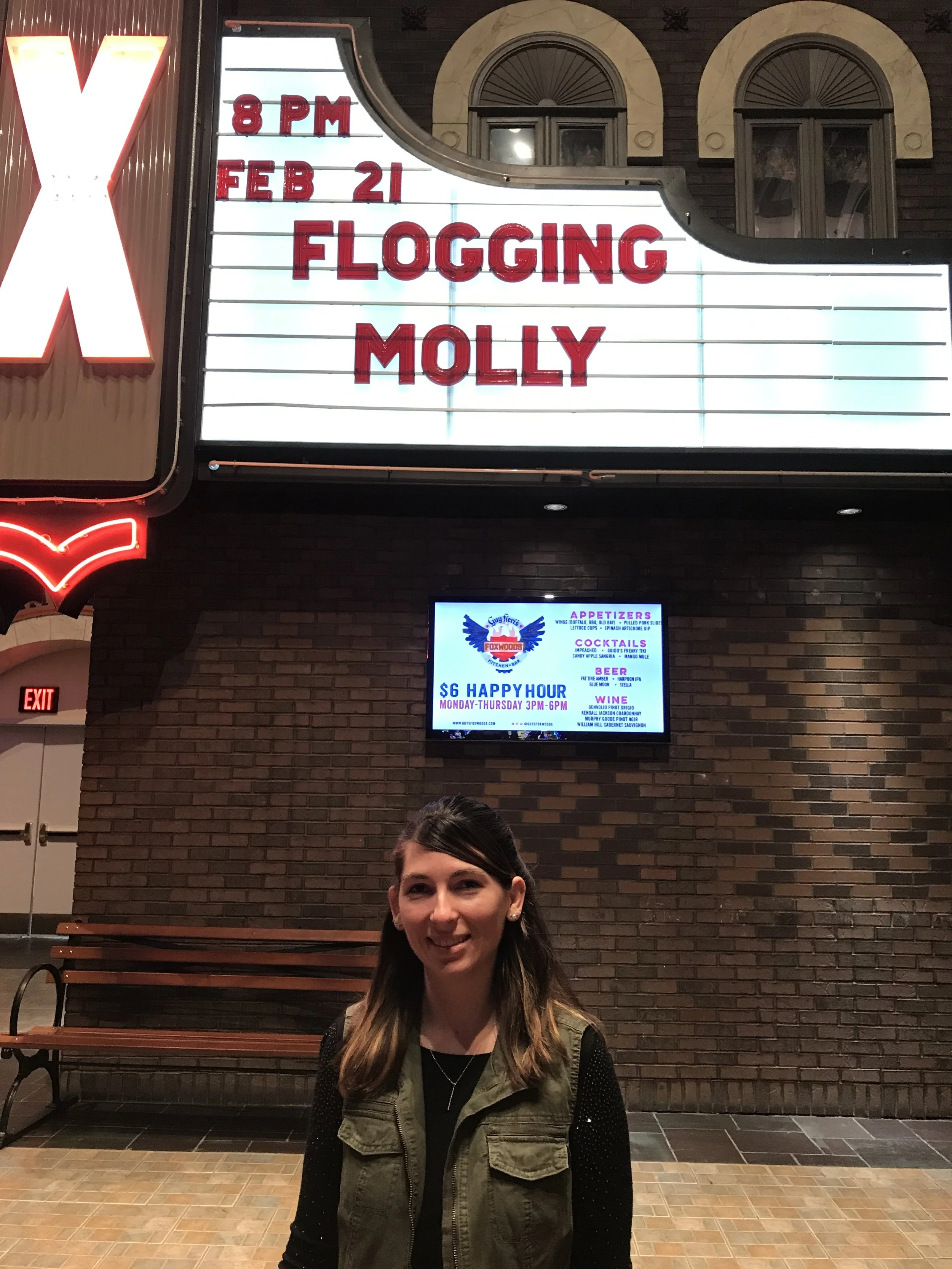
I’m excited that it’s March because being Irish is one of my most favorite things about life - it’s always so much fun to celebrate my heritage (but I celebrate year round!). This year, Flogging Molly came to town! They started their ‘Life Is Good’ tour at Foxwoods Casino. I had the time of my life! It brought back so many memories for me.

Growing up in an Irish family, my dad was a fan of Flogging Molly so it rubbed off onto me. People always got curious when I said that I liked a specific musician or a band because of my hearing loss. During my middle and high school years, I would learn the lyrics to any songs so that’s how I knew who I “like”. I never thought to listen to them but I started to in college after realizing that I could feel the bass and vibrations of the music when I went to few concerts. I can’t hear the words while the music is being played.

FMME.JPG

I don’t go to concerts often so I’m still learning about what it’s like when I do go. I thought Flogging Molly would be playing all new songs from their new release which I haven’t got around to research the lyrics or play them. While I was sitting at the concert feeling the bass and vibrations, I found myself feeling deja vu. I felt a sense of familiarity in the music.

There were couple years during college when I was homesick so I commuted the 2 hours drive every weekend. This is when I would blast any music in the car since I was alone on open and bare highway. Flogging Molly was played the most often.

So sitting there at Flogging Molly concert brought back those memories and I was surprised that I could recognize feeling the bass and vibrations after years! I was able to identify the song ‘Drunken Lullabies’ when they played it at the concert.

People were surprised when they saw pictures on my social media of me at Flogging Molly. Probably wondered how is that possible for me? Even through I have my hearing loss, I still enjoy the concert in my own way. On top of feeling the bass and vibrations of the songs, I enjoy the visual aspects of the concerts such as lighting, watching them play on their instruments, etc. I also can feel the excitement of concert-goers. At Flogging Molly, I enjoyed being around so many Irish people who were decked out in newsboys caps, Irish t-shirts, and tweed. It created a fun environment for me.

FM.jpg

This blog is not sponsored. All opinions in this blog are my own.

Lipreading: Where Every Sentence Is a Puzzle

The very first question that I get asked every time once someone finds out about my deafness is “can you lipread?” (and yes, they’re verbally asking me this). It’s a misconception that every deaf person knows how to lipread. It’s a skill that is learned. As mentioned in my background blog, I grew up in a mainstreamed setting so I learned how to lipread at a young age.

Lipreading is a difficult skill to learn. It varies on the level of hearing loss and preferred communication method - some deaf people may be experts but some may be lousy. Hearing people often think this is the best method of communication but it is not. I grew up in a mainstreamed setting so I use simultaneous communication - speech and sign language as my main method of communication with my family and friends. Signing is the easiest method of communication but I also use speech to help them understand me more since they don’t know EVERY word in sign language. I understand everything when they use sign language with me.

I lipread a little when I’m interacting with strangers in public like at the stores, appointments, etc. If I am aware of what the conversation will be about, I have the ability to lipread most of what is being said. For example, if I go into a coffee shop — I know they will be asking me what size cup, what kind of milk, do I want this added in the drink, etc. It throws me off if they started a conversation that is not topic-related. Often, I would panic and wonder “what are they saying?”. It will take me a few minutes to try and figure out what is being said.

Many people have asked me if it makes a difference if I’m in a one-on-one dialogue vs a group setting discussion. Either way, I am only able to catch a few words from the entire conversation. The benefit of having 1:1 conversation is that I am able to focus on one person and I can ask them to repeat if necessary. Forget it with a group setting! I never catch anything from multiple people talking and they don’t always directly look at me (which helps me to lipread). It is extremely difficult and most of the time I leave those groups wondering what the discussion was about.

One issue that I have faced while trying to lipread a stranger in a public setting is that they get annoyed with me when I ask them to repeat or gesture. They either give up or cut the conversation short. So many people do not realize that lipreading is a substantial task for deaf people. It really requires us to put in a LOT of effort. In the end, I always feel guilty for any miscommunication that happens which isn’t always my fault. I try to ask people to write since that is better than lipreading.

You wouldn’t believe the misunderstandings that can happen from attempting to lipread! When I’m in a dialogue with a stranger, I am likely to catch a few words so I play the whole “fill in the blank” game. There have been some assumptions where I was entirely wrong and made the situations very awkward!

How long does it take me to lipread a new person that may come in my life? I am almost always the only deaf person at my job. How do I communicate with my hearing co-workers? I do have to lipread most of them. It is always challenging when I work with new co-workers. It does help when I see them daily and practice lipreading them. It takes me about a month and a half (of seeing them daily) to be able to lipread the majority of what they are saying but I do still occasionally miss some words.

Many people also don’t realize there are things that can prevent me from lipreading! One time at work, we lost power so we were in complete darkness. A co-worker started talking to me but I couldn’t see their lips in the dark! There have been some men that I wasn’t able to lipread because of their mustaches or beards. I can’t read lips when they’re covered with facial hair. It can be very distracting to lipread when someone has objects in their teeth/mouth or any kind of deformity around their mouth.

Accents also prevent me to lipread since people pronounce their words differently. I’ve traveled to Ireland twice where I’ve met many friends. They all spoke English but pronounced their words differently so I wasn’t able to lipread. I have came across New Englanders with strong Boston accents, which again I can’t lipread. I wasn’t raised in Boston so I never learned their pronunciations.

In the end it’s best that you do not assume that all deaf people can lipread. Don’t be afraid to ask them what their preference method of communication is. Most of the time it will be writing on paper or gesturing. Of course it’s most helpful if you know sign language!

All opinions in this blog are my own.

Growing up Deaf

One of my hopes with this blog is to broaden the awareness of deafness. I will be sharing what it's like being deaf. All opinions and experiences in this blog are my own, it does not reflect the opinions or experiences of other deaf people.

Throughout my life I have met many people curious about my deafness, most often these are people who have never know a deaf person or who have had only limited exposure to the deaf community. I encourage people to ask me questions, because I want to bring awareness of deafness into main stream culture. I hope you can learn from me and feel free to email me your inquiring questions! 

Let's start with the background of my deafness. I was born with profound hearing loss with no history of deafness in the family. My parents, brother, grandparents, and relatives are hearing. I use simultaneous communication (sim-com) with sign language and spoken English as my main communication method.

I was born in New Jersey so I lived there for the first few years of my life. When I was 6 months old, my parents noticed that I was not responding to sounds so they brought me to a doctor. The doctor stood adjacent to me and clapped his hands. Naturally I reacted by looking at him, he said “nope, she’s fine.” My parents brought me home with doubts in the back of their minds. When I was 9 months old, we visited family in Upstate New York. This is when they expressed the concerns to my aunt who was a college student majoring in speech therapy. My aunt scheduled a hearing test which this is where my parents were told that I am deaf. The people who did the testing did not want to commit to the level of my hearing loss so they suggested my parents schedule a testing with audiologist. My parents took me to an audiologist in Philadelphia, Pennsylvania. The audiologist confirmed my hearing loss but said the hearing loss was only moderate. I was fitted with hearing aids that suited that level.

My parents began to research schools for me to attend, two schools came highly recommended: Helen Beebe Speech and Hearing Center in Easton, PA and Summit Speech School in New Providence, NJ. Both of these had focuses on auditory/oral education. It was decided that I would go to Summit Speech School since it was 45 minutes closer to my home. I went there three times a week for 1:1 sessions. The staff worked with me to pronounce sounds.

While I attended Summit Speech School, they had suspicions that my hearing loss was greater than what my parents were told. They recommended to get another hearing test. My parents took me to Beth Israel Medical Center in Newark, NJ. It was discovered then that I had profound hearing loss! I was fitted with another hearing aid that was suited better for profound hearing loss.

My parents and I moved to Upstate New York to be closer to family. My parents felt the stress and uncertainty of raising a deaf child so they wanted the support of the family. I went from Summit Speech School in NJ to a program at Elmira College. The only difference was that Elmira College used “total communication” - usage of both spoken English and sign language. This is when I learned sign language. My parents had hesitancy about me using sign language because Summit Speech School told them that it was bad! Fortunately, I never dropped the speech part. My parents started taking sign language classes shortly after so they can communicate with me.

I grew up the majority of my life in Upstate New York. I attended a mainstreamed school. I was the only deaf student with no pre-existing conditions. I had a support team that consisted of a Teacher of the Deaf, interpreter, and a note taker. A deaf community was nonexistence during my childhood because all of my peers attended school for the deaf 2 hours from my home. Before you ask why didn’t I go to the deaf school too… I promise a future blog post about it.

After high school graduation I attended the deaf college, National Technical Institute for the Deaf (NTID), at Rochester Institute of Technology in Rochester, NY. This is when I finally was able to be a part of the deaf community. Those years in Rochester probably were the most challenging time in my life discovering myself as a deaf individual. It taught me a lot about finding my place in this world.